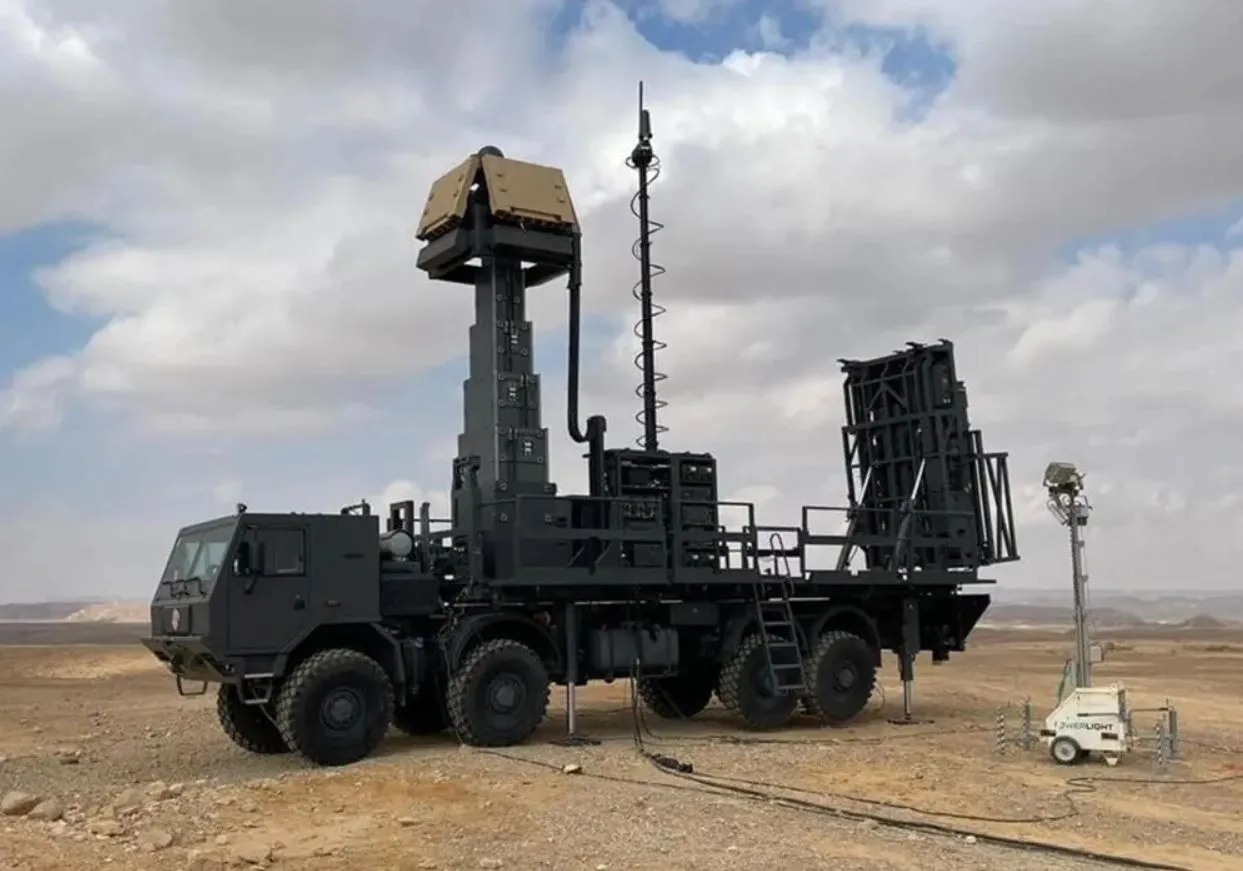
SPYDER Air Defense System Arrives in Morocco
Recent satellite imagery has unveiled that Morocco has successfully integrated the SPYDER air defense system, which stands for Surface-to-Air Python & DERby, into its territory. This significant addition marks a crucial milestone in Morocco's aerial defense strategy, following a series of negotiations and interests that were first disclosed exclusively by defensa.com in March 2023, highlighting Rabat's interest in this advanced system.
The SPYDER system, notable for its desert camouflage, was identified at the Sidi Yahya El Gharb air defense base, located northeast of the capital, Rabat. This base is already home to various mid- and long-range defense systems of both Chinese and Israeli manufacture. Although the images lack clarity, they reveal the presence of seven SPYDER system trucks, with at least two vehicles attracting particular attention. One truck appears to be deploying the ELM-2138 radar mast, indicating that Morocco has likely acquired the SPYDER All-in-One version, which is designed for short and medium-range engagements. Another truck is seen towing the EL/M-2084 radar, typically associated with the standard configuration of the medium to long-range (MR/LR) version. What stands out in the Moroccan configuration is the use of TATRA 8x8 truck chassis, enhancing mobility and rapid deployment capabilities.
Capabilities and Strategic Importance of SPYDER
The SPYDER system, developed by Rafael Advanced Defense Systems of Israel, is engineered to provide a defensive umbrella over strategic points, mobile forces, and urban areas against a wide array of threats. It is capable of engaging multiple targets simultaneously, making it particularly effective against suicide drones, glide bombs, and even tactical ballistic missile interceptions in its MR/LR variants. The system employs a combination of missiles, including the Python-5, which features an electro-optical seeker that integrates dual-band thermal imaging with electronic imagery, alongside the I-Derby-ER missiles, which are equipped with a dual-pulse engine to enhance long-range performance.
The SPYDER family includes various versions ranging from short to long-range capabilities, all characterized by rapid response times and the ability to operate on the move, detecting and engaging threats within seconds. With a 360-degree coverage and operability under all weather conditions, the SR and ER versions can lock onto targets before launch with a lofted shot, extending their reach up to 40 kilometers. In contrast, the MR and LR versions offer vertical launch capabilities that can cover distances of up to 160 kilometers. The new 'All-in-One' version consolidates the radar, electro-optical and infrared sensors, and the launcher into a single platform, enabling it to meet the demands of complex modern combat scenarios as an autonomous entity capable of countering saturation attacks.
This system is the only Israeli air defense system incorporated into NATO's air defense framework. The operational requirements stemming from the conflict that began in October 2023 have prompted Israel itself to procure the SPYDER system. Currently, eight countries utilize this system, showcasing its diverse operational history. The United Arab Emirates is believed to be the first Arab nation to adopt it, while the Czech Republic was the first NATO member to deploy it. Additionally, it is in service with the armed forces of Georgia, Vietnam, Singapore, and the Philippines.
Morocco's acquisition of the SPYDER system occurs against a backdrop of regional tensions marked by Algeria's acceleration of its military capabilities, including the acquisition of modern Russian fighter jets such as the Su-57, Su-35, and Su-34. Meanwhile, Morocco faces delays in upgrading its F-16 fighters to the 'Viper' standard and awaits new batches of Block 72 aircraft. In light of this temporary gap, turning to a highly efficient ally in air defense, such as Israel, appears to be a practical solution for Morocco to address its vulnerabilities and restore the balance of deterrence in ground-based air defense.
As reported by defensa.com.