For a long time, Morocco's tourism narrative was defined by its enchanting medinas, traditional riads, bustling souks, majestic red palaces, and golden deserts. While this picture still holds true, it no longer tells the whole story. A new geographical narrative is taking shape along the Atlantic coast in the northern region of the kingdom, one that is more contemporary and ambitious. From Rabat-Salé to Tangier, with the dunes of Larache in between, three destinations reveal a Morocco that is progressing without forgetting its rich past.
Rabat-Salé: Morocco Reaching New Heights
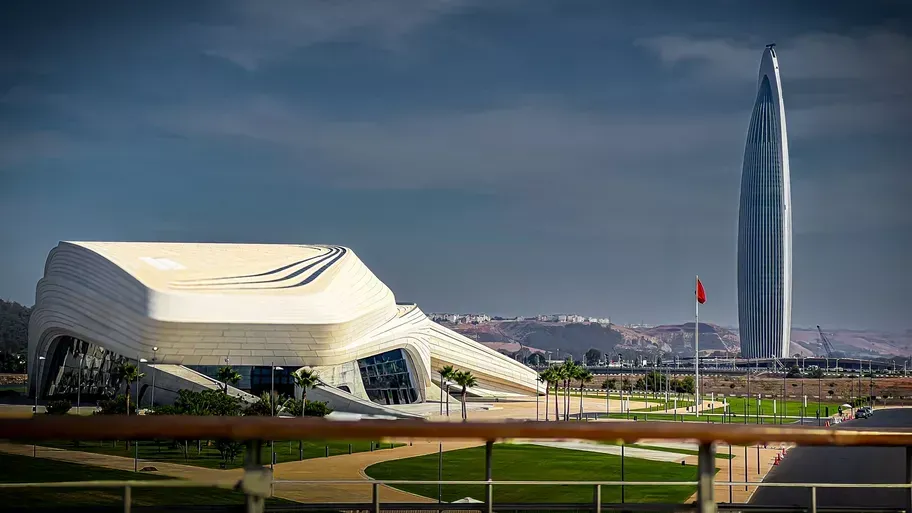
Visible from afar, the Mohammed VI Tower in Salé, facing Rabat, stands as a striking symbol of ambition rather than just another building. Soaring to a height of 250 meters, this glass and steel structure boasts fifty-five floors and a design reminiscent of a rocket. It boldly asserts its presence in the landscape without seeking permission. This dramatic silhouette emerges alongside the Bouregreg River, with Rabat, the political and historical capital, on one side, and Salé, which has long remained overshadowed, on the other. The tower seems to declare that Morocco is not merely aiming to charm but also to impress.
This skyscraper, one of the tallest in Africa, signifies a transformation in the kingdom’s image, showcasing Morocco as a stable, connected nation focused on business, high-end tourism, and major international events. It represents a shift from the traditional image of Morocco filled with patios and lanterns—though those are still appreciated—towards a Morocco that speaks of skylines, soft power, high-speed trains, and the upcoming 2030 World Cup.
Within the tower, the Waldorf Astoria Rabat Salé offers a unique experience with just fifty-five rooms and suites, providing an intimate atmosphere amidst its grand design. Adorned with light marbles and sky-inspired patterns, the hotel features attentive concierge services, a suspended spa, panoramic restaurants, and art at nearly every corner. The luxury here is calm and courteous, perhaps slightly cold, providing a space to relax without the pressure of feeling like an entrepreneur in a djellaba.
The most striking aspect remains the breathtaking view. From this height, one can appreciate the beauty of Rabat, Salé, the river, the Atlantic Ocean, bridges, and the theater designed by Zaha Hadid, all illuminated at sunset. Everything appears clearer from above, even the traffic seems subdued. However, the tower is still surrounded by an environment that is in the process of finding its identity; it lacks the density, vibrancy, and delightful chaos of a true neighborhood. But perhaps that very fact reflects the current state of development: a landscape being constructed right before our eyes.
Waldorf Astoria Rabat Salé offers luxurious accommodations starting at 700 euros per night.
Larache: Grounded Luxury Amidst Nature
After the verticality of Rabat-Salé, the pace shifts as we head towards Larache, a region characterized by its wild coastline, rolling hills, dunes, and vibrant Atlantic. Here, La Fiermontina Ocean seamlessly integrates into the landscape rather than dominating it. The project, envisioned by Fouad Filali and his sister Yasmina Antonia Filali, is a testament to their family’s rich history that spans Morocco, Italy, and France. Fouad, a Moroccan and former leader of the ONA group, returns with a personal vision: to create a luxury hotel in an area still untouched by major tourist routes, emphasizing genuine connections with local communities.
This commitment to community is a highlight of the establishment. While many contemporary hotels tout sustainability and social impact, often superficial, La Fiermontina Ocean demonstrates a more authentic approach. Some accommodations are integrated into the village of Dchier, with local residents trained and employed in various roles. Women from nearby villages host travelers in their homes for breakfast, fostering deeper connections. The project progresses in collaboration with the Fondation Orient-Occident, aiming not just to take advantage of the landscape but to actively participate in its development.
The atmosphere on-site reflects this intention. The villas and suites embody discretion, featuring local stone, low-profile lines, private pools, expansive ocean views, and a profound sense of tranquility. The hotel feels like a refuge at the end of a road rather than an isolated bubble. Here, luxury is not about escaping the world but listening to it more attentively. It’s essential to appreciate the isolation; those seeking a rooftop DJ and neon cocktails named “Sahara Kiss” might need to look elsewhere. Even the so-called "Beach Club" offers only the serene sound of the sea, which is perfectly acceptable.
La Fiermontina caters to travelers who embrace the winds, the slow pace, the Atlantic light, dirt paths, and the passage of time without justification. This rare luxury—a location that doesn't shout its exceptionalism—is indicative of the Morocco that lies ahead: not a place of grand architectural gestures alone, but one capable of cultivating a more refined, local, and responsible tourism in areas still underexplored. A tourism that doesn’t transform each village into a backdrop but seeks, with caution, to make it a partner. This may not be simple, but here, the intention feels genuine.
La Fiermontina Ocean offers elegant accommodations starting at 400 euros per night.
Tangier: A City Reawakening
Then comes Tangier, a city rich in narrative and complexity. For a long time, Tangier was impossible to summarize: it embodies a blend of African and European, Mediterranean and Atlantic influences, and serves as both a Moroccan and international hub, exuding elegance and intrigue. In the 1950s and 60s, it drew writers, musicians, beatniks, and diplomats, becoming a haven for those seeking freedom and sometimes a paradise for those who lost their way.
However, its charm began to wane. For decades, Tangier seemed to live off its legend, which can be dangerous; legends, when neglected, start to smell of mothballs. Yet, the city is making a comeback—not merely out of nostalgia but through significant developments: a new port, high-speed train connections, a marina, restoration of the medina, a burgeoning local art scene, galleries, cafés, and contemporary boutiques. Tangier is reclaiming its identity as a vibrant Moroccan city, no longer just a backdrop for foreign fantasies.
This revitalization makes it an exciting destination today. Visitors can stroll through the medina, ascend to the kasbah, linger at the Grand Socco, enjoy coffee at the iconic Café Baba, gaze across the strait, trace the footsteps of literary figures, visit the Cinémathèque de Tanger, explore artisan workshops, wander through winding white and blue alleys, and finally find themselves facing the sea, experiencing that rare sensation of being on the brink of multiple worlds.
Perched on the hills, the Fairmont Tazi Palace Tangier embodies this renaissance. Originally designed in the 1920s for Ahmad Tazi, the palace has been restored into a luxurious hotel. While it’s not located in the bustling heart of the medina, it sits slightly apart, surrounded by eucalyptus trees, overlooking the city like a pasha’s residence that has discovered room service.
This location is both an advantage and a limitation. Guests wanting to dive straight into the Tangier buzz will need to drive, while those who appreciate the serenity of returning to an elegant retreat after a day in the medina will find gardens, spacious areas, zelliges, terraces, a pool, a spa, and stunning views. The Fairmont does not embrace the beatnik bohemian lifestyle; instead, it presents itself as a refined palace. It’s not Burroughs at the counter at three in the morning; it’s more about returning to one’s room in a robe, enjoying a hammam, and finding perfectly pressed pillows. We all grow older.
Ultimately, these three stops tell a cohesive story: the Atlantic Morocco is entering a new chapter. Rabat-Salé gazes skyward, Larache forges a connection with the earth, and Tangier rekindles its legend while striving not to become trapped by it.
This could be the essence of the new Morocco: a country that no longer feels the need to choose between tradition and modernity, between palaces and skyscrapers, between villages and grand hotels. It is moving forward on multiple fronts. And along this Atlantic coast, its new identity is becoming increasingly clear.
Fairmont Tazi Palace Tangier offers luxurious stays starting at 420 euros per night.
As reported by parismatch.com.