Exploring the Uniqueness of López Pangue Winery
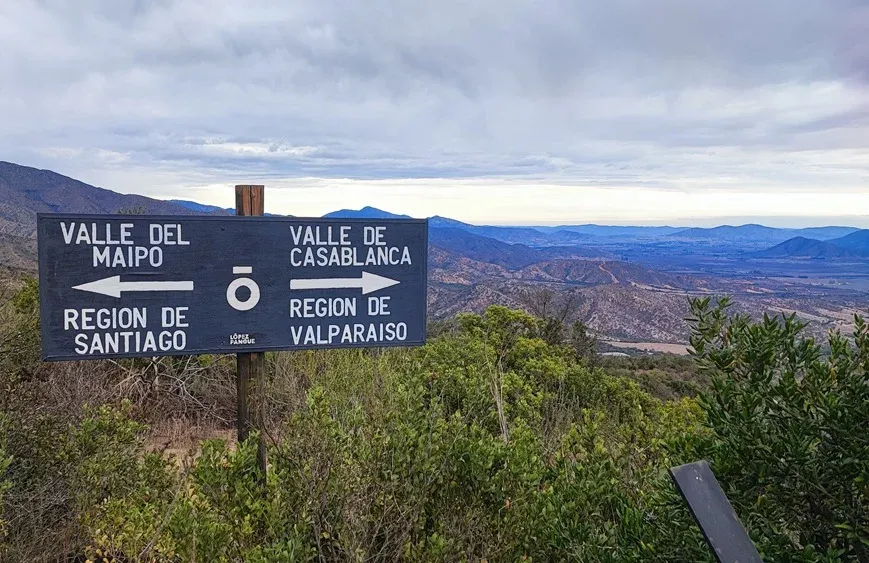
Located in the stunning **El Pangue Valley** within the Curacaví commune, López Pangue Winery offers a distinctive wine experience that is closely tied to its unique geographical position. On the very day the catastrophic rains of July began to affect central-northern Chile, we ascended to the highest viewpoint of López Pangue, traversing a path that meanders through hills, native forests, and steep slopes, ultimately leading to a summit nearly one thousand meters above sea level. A prominent sign indicates that although López Pangue is associated with the **Maipo Valley**, it is much closer to **Casablanca**. This unusual positioning significantly influences the character of its wines.
The vineyard is situated at approximately 650 meters above sea level, about 40 kilometers from the ocean, blending continental and, to a lesser extent, coastal conditions. This unique climate is sufficiently cool, allowing for snowfall approximately every six years. **Félix López**, the founder of the project, asserts, “We truly believe it is a microclimate. The proximity to the sea combined with the altitude is not common across Chile’s wine regions.”
The Challenges and Triumphs of Growing Grapes
Following my visit, the exceptional 315 millimeters of rainfall that fell in the days afterward would directly determine the water availability for the growing season. The estate is equipped with ten underground wells that vary in flow and a storage reservoir that can sustain the vineyard for two to three months, particularly crucial during February, March, and April when well performance decreases while fruit remains on the vines. **Antón López**, Félix's son and now responsible for the day-to-day operations, recalls recent years where annual precipitation reached 690 and 480 millimeters. In stark contrast, 2019 saw a mere 67 millimeters. “The neighbors’ wells in Casablanca rely on underground aquifers,” he explains, “but here, it’s like a stone cup: what you have is what it rained, and if it didn’t rain, there’s no water.” Thus, on their 28 hectares planted across diverse slopes, the challenge is to conserve water and manage it judiciously until the last grape enters the winery. Cultivating vineyards without irrigation, relying solely on rainwater, has become an integral part of their management strategy.
For nearly a decade, the López family sold their grapes while reserving small quantities to experiment with winemaking at friends' wineries in Casablanca. “We would gather around 500 bottles each year,” recalls Félix, reminiscing about the powerful wines made from extremely ripe grapes, which was the trend at the time. The family's connection to wine runs deep; Félix's grandfather was born in Soria, and his mother hailed from La Rioja. They operated a winery in Valparaíso dedicated to popular wines sourced from Cauquenes and Itata, where Félix spent his summers as a child.
The pivotal moment came when Antón completed his economics studies and agreed to join the project. He had developed a thesis on small wineries and, upon discussing the future with his father, they decided to build the winery together rather than limit the project to grape sales. The winery began operations just over three years ago, overseen by winemaker **Paula Cárdenas**, with viticultural advice from Pedro Izquierdo. A combination of stainless steel, French oak barrels, cement, and clay is utilized for crafting small batches of wine while striving to preserve the fruit's expression.
The motto of López Pangue since they began bottling their own grapes has been “Wine from here.” This straightforward phrase encapsulates their commitment to using only estate-grown grapes and producing all wine onsite. This philosophy extends to the winery itself, where earth removed during excavation has been incorporated into the walls, along with stones from the land, remnants of ancient gold mining activities.
In addition to vineyards, organic orange trees, planted by Félix and his sister, now encircle the family property. Their chemical-free farming practices extend to other crops as well. The oranges delight visitors, appearing as slices in welcome water, transformed into marmalade paired with local goat cheese, or served as a dessert with honey and nuts sourced from the estate.
López Pangue also produces its own olive oil. Félix discovered the olive trees while horseback riding in the hills and relocated them to the entrance of the property for easier access. Thus, “Wine from here” encompasses not only the grapes and wines but also the clay, stones, oranges, olives, honey, nuts, and relationships with neighboring ventures.
Paula Cárdenas shares that the project initially aimed to produce only red blends, but the outstanding performance of the individual varieties has led them to recently bottle small varietal batches as well. “We realized that varietal wines were incredibly interesting due to the climate,” Paula explains. “The Carmenère here is very different, as well as the Durif or Petite Sirah and Malbec. Hence, we decided to continue with the blends while also producing some varietals.” The wines maintain a commonality of acidity that respects the right maturity of each grape variety, resulting in vibrant fruit and a tension that leans more towards a cooler climate than the traditional Maipo profile.
The Carmenère exemplifies this border condition, maturing late and facing the risk of insufficient ripeness in excessively cold years. When the growing cycle is completed, it yields a Carmenère rich in black fruit, spices, and pepper, presenting a juiciness and freshness that surpass many traditional expressions of the variety. In addition to the classic blends featuring Cabernet Sauvignon, Cabernet Franc, Syrah, and Carmenère, López Pangue has introduced a refreshing Malbec rosé and is set to launch a new Petite Sirah filled with exuberance. Among all the varieties, Verdejo, the only white wine produced, holds a particularly intriguing story.
Félix recounts his desire to recover the Semillon he remembered from his grandfather's old winery. He commissioned the plants from Emilio, a cousin who worked with the family, and for years believed that was what had been planted. Doubt arose when his viticultural consultant observed that the leaves did not match Semillon. After analysis, it was revealed to be Verdejo. By then, the person who had purchased the plants no longer remembered their origin. What began as a mistake transformed into an opportunity.
Paula ferments the Verdejo in stainless steel before transferring it to cement eggs, with a small portion undergoing aging in used barrels, aiming for a subtle contribution to texture without being overt. The excellent reception of this variety, of which there are only about seven hectares in all of Chile, has prompted new grafting, a dry farming plantation, and the acquisition of a press for better yields. Antón attributes its success to its fresh profile, lacking sharp acidity—since this is not a cold climate—while maintaining a broad mouthfeel.
The visitor experience at López Pangue begins on a winter day, with a lit fireplace and steaming pots in the open kitchen. The layout allows for a seamless flow between the winery, dining area, and home. Sebastián Romero, who guided us through the valley in a buggy, oversees tourism, although the project's scale permits the owners and team to remain actively involved. Félix and Antón engage with visitors, Paula appears from the winery through a glass door, and the table fills with their own and local products. The meal concludes with a cherry liqueur made right there, of course.
“Wine from here” succinctly explains this project, which, although still in its infancy, has already managed to distinguish itself with wines that do not resemble others—neither those of the same Maipo region nor those from nearby Casablanca.
As reported by 7canibales.com.