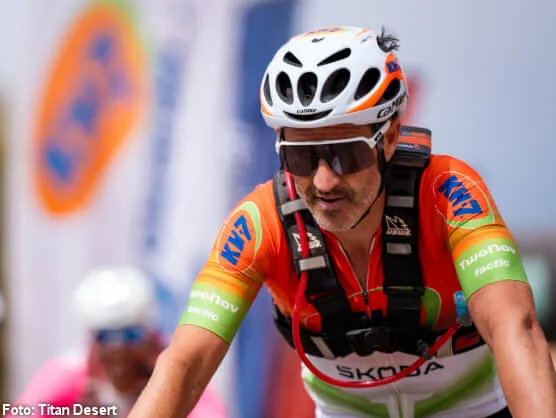
The Titan Desert's much-feared dune stage unfolded on April 30 in Merzouga, Morocco, marking a significant achievement for debutante Dani Moreno from Madrid, riding for KH7. Moreno outpaced his teammate Ángel Luis Maté, who wore the red jersey, and Portuguese cyclist Bruno Rosa in a thrilling sprint that defined the day's competition. This victory not only highlights Moreno's skill but also underscores the camaraderie and strategy among friends who have shared the cycling path for years.
In a compelling twist of fate, Moreno’s victory also served as a nod to their shared history. In 2016, during the European Road Championships, Maté played a crucial role in helping Moreno secure a bronze medal, and a decade later, their partnership proved instrumental in ensuring that both the stage win and the leadership remained within their team. However, the day was marred by misfortune for others in the top ten, with Luis León Sánchez unable to start and Alberto Guerrero suffering a collarbone fracture mid-race. Additionally, two-time stage winner Noel Martín faced a mechanical failure, further shaking the leaderboard.
This unexpected turn of events opened the door for Dutch cyclist Tessa Kortekaas from Massi ISB, who finished sixth in the stage and climbed to eighth overall—an unprecedented achievement in Titan Desert's history. The fifth stage, which started and ended in Merzouga, spanned a challenging 87 kilometers filled with exhilarating moments. Dani Moreno, a retired cyclist who last raced professionally in 2018 with EF Education, displayed remarkable adaptability on his debut, having transitioned to gravel cycling where he honed his skills. His time of 3 hours, 14 minutes, and 18 seconds, averaging 26.87 km/h, was a testament to his capabilities, as he and Maté maintained their positions at the forefront of the race, collaborating effectively through the dunes of Erg Chebbi, a breathtaking backdrop for their competition.
Moreno’s victory adds another accolade to his illustrious career, which includes 22 wins on asphalt, featuring notable victories in prestigious races like the Flecha Valona and three stages of the Vuelta a España. Since his retirement, he has embraced gravel riding, which he believes has significantly contributed to his cycling prowess. “Since I stopped being a professional, I've been riding my gravel bike all day, and that really builds a lot of skill. With this suspension, I flew over the rocky sections. Gravel cycling is a different vibe altogether. I’m very happy with this victory; it’s my first, and the experience here is fantastic, especially interacting with others,” he reflected.
Meanwhile, Maté, who recently claimed victory in Titan Patagonia, stands on the brink of his first crown in Morocco, although he remains cautious. With a lead of 9 minutes and 50 seconds over Rosa and a substantial 34-minute advantage over Vicente Quiles, Maté knows that the Titan Desert can test even the most prepared athletes. “It's true that I have a good lead, but just look at what happened to Noel Martín. You can’t celebrate until the end. The Titan pushes you to your limits, both physically and mentally, as well as with your equipment. I need to proceed with caution to avoid any mishaps or bike failures,” he stated, embodying the spirit of a true competitor.
On the women's side, Tessa Kortekaas continues to dominate the current edition of the Titan Desert, securing her fifth consecutive victory and further solidifying her status as a leading contender. Her sixth-place finish in Merzouga elevates her to eighth overall, marking a historic milestone in the Moroccan race. “I feel a bit guilty for advancing in the general standings due to the withdrawals of Luisle, Pablo Guerrero, and Noel Martín, but that’s cycling. I’ve felt somewhat fatigued, but I performed well in the dunes despite my navigation doubts. With one stage left, I hope to maintain my position,” commented the leader, showcasing her determination.
The final stage of the Titan Desert will unfold on Friday, featuring a 74-kilometer route from Merzouga to Maadid, with a challenging elevation of 650 meters. Cyclists will navigate through uncharted and rarely traveled desert landscapes, making it far from an easy ride, as rocky sections and steep descents will alternate with fast tracks, riverbeds, and soft areas before reaching the classic finish line at Maadid.
As reported by esciclismo.com.