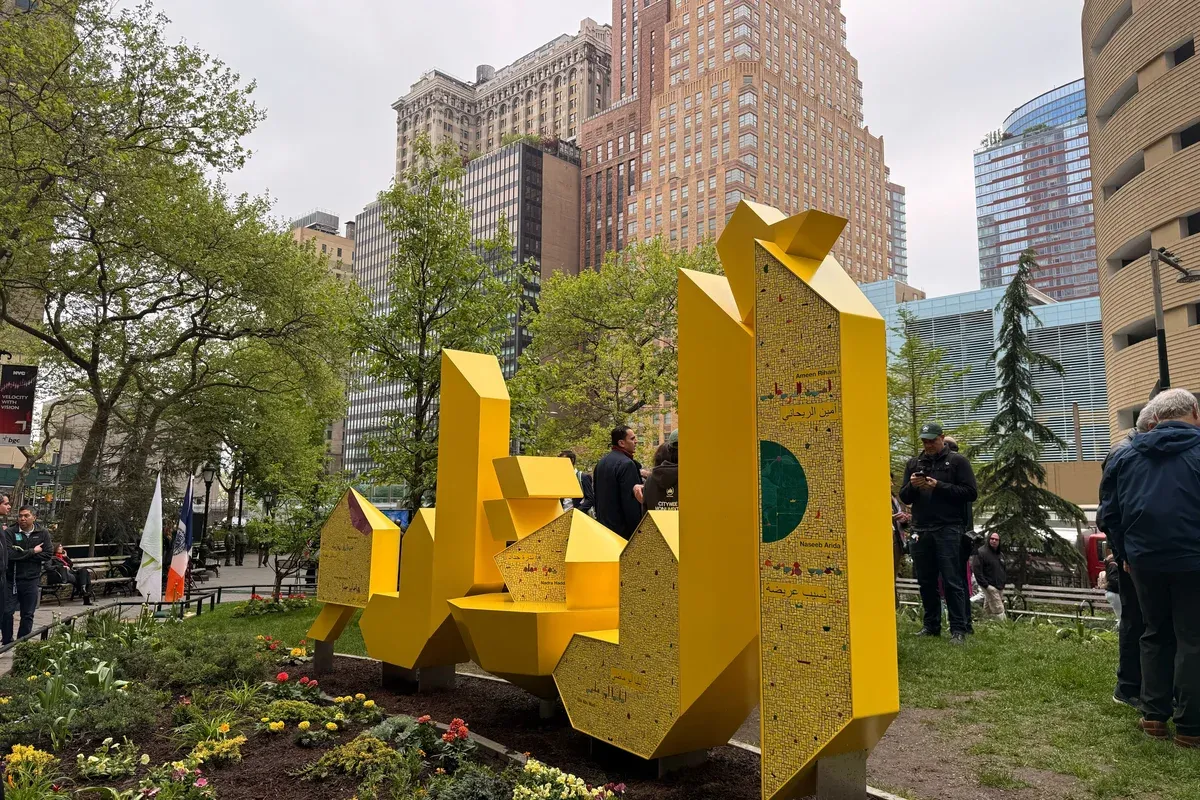
A newly unveiled permanent public artwork in Lower Manhattan, which has taken over a decade to come to fruition, pays tribute to the historic "Little Syria" community that once flourished in the area. On Thursday, the city parks department introduced the multipart monument titled "Al Qalam: Poets in the Park," created by French Moroccan artist Sara Ouhaddou. Situated within Elizabeth H. Berger Plaza in the Financial District, this artistic installation honors New York's first Arabic-speaking community, which thrived from the 1880s until the 1940s, and celebrates its rich literary legacy.
The centerpiece of the monument is a vibrant yellow 3D sculpture symbolizing the Arabic word "al-qalam," which translates to "the pen." This sculpture is crafted in an abstract alphabet designed by Ouhaddou and adorned with intricate mosaics and plaques that commemorate the writers it celebrates. Alongside this captivating sculpture, two elongated, curved benches covered in bright yellow mosaics have been integrated into the existing stone seating nearby. These benches feature excerpts from the works of nine prominent writers, including Elia Abu Madi, Nasib Arida, and Kahlil Gibran, all rendered in Ouhaddou’s colorful calligraphy.
In a bid to enhance visitor engagement, the Washington Street Historical Society, which advocated for the artwork, has developed an augmented reality app that allows users to scan the mosaics with their smartphones and access audio and written excerpts in both Arabic and English. During the unveiling, Ouhaddou reflected on the significance of translation and cultural heritage for immigrant communities, stating, "This community was one of the first who really questioned the idea of translation, and it's a core question when you're an immigrant: translating the culture you come from. I pondered how the younger generation from the diaspora would translate the cultural legacy we inherit, which inspired my creation of a unique alphabet that is abstract and somewhat unreadable, signifying a forward-looking perspective rooted in the traditions of past poets and artists."
The historical significance of Little Syria lies in its vibrant community of authors and poets, notably the al-Rabitah al-Qalamiyah writers' association, which played a pivotal role in shaping modern Arabic literature. Unfortunately, this culturally rich neighborhood was largely demolished in the 1940s to accommodate extensive construction projects, including the Brooklyn-Battery Tunnel. The conception of this project dates back to 2011 when members of the Washington Street Historical Society began efforts to restore the history of Little Syria. Following the devastation caused by Superstorm Sandy, the city announced plans to enhance the park, and in 2017, Ouhaddou emerged victorious in a city-sponsored competition for artists.
Linda Jacobs, the president of the historical society, expressed her excitement about the project's completion, remarking, "It's completely and utterly thrilling. None of us quite believed that it would actually happen due to the long and arduous process filled with numerous obstacles, including COVID-19. However, with everyone’s support, we achieved our goal." The monument now joins over 800 permanent installations within the city’s parks, contributing to a diverse collection that aims to reflect the artistic and cultural narratives of New York City. Parks Commissioner Tricia Shimamura emphasized the importance of art in public spaces, stating, "It’s incredibly important to be adding to that collection now more than ever, to really ask ourselves, ‘Who is art for and what spaces can art be found in?’ The answer, at least for the parks department, is everywhere; art is for everyone."
As reported by gothamist.com.