Championing Agricultural Sovereignty in Morocco
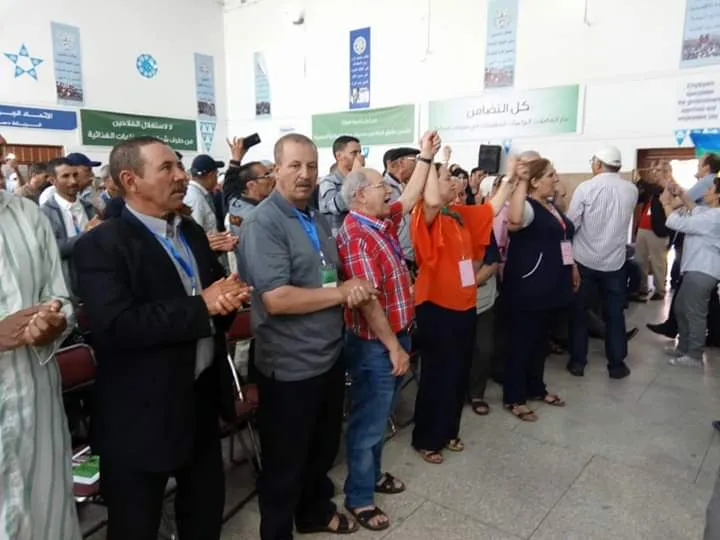
Issued by the National Union of Peasants, affiliated with the National Federation of the Agricultural Sector (FNSA) under the banner of the Moroccan Labor Union (UMT), this statement aims to address the public and relevant government authorities during the International Agricultural Fair in Meknès (SIAM 2026). As we gather for the 18th edition of this significant event, we stand at a historical crossroads, compelled to unveil the truths obscured by the glimmering lights of this fair. It is undeniable that Moroccan agriculture is currently in a distressing state, characterized by a stark dichotomy between its polished exterior and the grim reality faced by small and medium-sized farmers, as well as the broader Moroccan populace.
The theme of "food sovereignty" raised for this year's fair remains a hollow phrase unless it liberates itself from the shackles of "dependency" and the merciless logic of the market that oppresses genuine producers. We firmly declare that the struggle we wage today in our fields and villages is not an isolated battle; the cry of Moroccan farmers against marginalization and debt—stemming from water, land, and dignity—is a resounding echo of the struggles faced by millions globally who have chosen to stand with the land against the voracity of transnational corporations. We affirm that the rights of Moroccan farmers to their land, seeds, water, and free decision-making are not mere "concessions" granted by any authority; they are inherent rights enshrined in the United Nations Declaration on the Rights of Peasants (UNDROP).
Our cause in Morocco, which confronts "corporate plundering" and "chronic indebtedness," is part of a larger human struggle to reclaim food from the hands of speculators and restore dignity to the true cultivators of the land. The concept of food sovereignty celebrated at this fair will remain devoid of substance unless it begins with "genetic independence." We cannot speak of dignity or agricultural sovereignty while efforts are made to reduce our farmers to "permanent clients" of transnational seed corporations, through hybrid seeds that yield only once—thus severing the historical continuity of Moroccan farming. We clarify that we are not against progress; rather, we reject genetic dependency and demand the full implementation of UNDROP, particularly concerning farmers' rights to conserve, use, and exchange their seeds.
Protecting "local seeds (baladi)" is tantamount to safeguarding our historical agricultural memory and ensuring food security against the fluctuations of global markets and the whims of foreign laboratories. Presently, the issue surrounding the "generalization of Mandatory Medical Insurance (AMO) to farmers" has coldly morphed into a "social liquidation." Small farmers are being coerced into "renouncing their professional identity," erasing the designation of "farmer" from their national identity documents, merely to escape the burden of debts and fines for delays. This is a grave indictment of a program that was intended to be social. How can it be reasonable to demand that a farmer, battered by years of drought, pay dues exceeding their means—under threat of confiscating what little remains to them—while billions are lavishly allocated as subsidies for large exporters? We demand a "comprehensive exemption and human reconciliation" to restore pride in farming as a profession and to establish social protection as a right, rather than a pretext to terminate their professional and social existence after decades of discrimination. Currently, billions are directed toward supporting exports and large landowners (15%), while 85% of Morocco's farmers are left vulnerable, exposed to drought, debts, and intermediaries.
Continuing down this path risks jeopardizing social peace and the true food security of the Moroccan people. As the wells of small farmers run dry and rainfed lands crack, we witness the emergence of "artificial oases" where the national aquifer is drained to produce water-intensive crops (dates, avocados, watermelons…) exclusively for the luxury of foreign markets. Therefore, we declare that water is a public asset belonging to the Moroccan people, and absolute priority must be given to "subsistence crops" that ensure bread for Moroccans, rather than "cash crops" that line the pockets of a select few speculators, leaving behind rampant inflation and thirst for future generations.
We demand a "democratic water planning" that supports deep rural areas and small farmers as guardians of the environment, land, and our nation's food sovereignty. Consequently, the National Union of Peasants asserts the following: food sovereignty is not imported in containers; it is sown in villages, beneath the shade of olive trees, and nurtured by the hands of diligent farmers.
As we engage in the International Agricultural Fair in Meknès, it must serve as a moment to restore dignity to hardworking and medium-sized farmers, rather than marginalizing them, entrenching their crisis, and obscuring the failures of an agricultural model that prioritizes interests above national needs. In light of the International Agricultural Fair, the National Union of Peasants reaffirms the essential role of hardworking and medium-sized farmers in safeguarding our food sovereignty, while also highlighting the alarming deterioration of their conditions, calling for the enactment of policies and the initiation of public programs—through their participation—to strengthen their contributions toward guaranteeing our nation's food sovereignty and achieving rural development that upholds human dignity for the entire rural population.
As reported by viacampesina.org.