
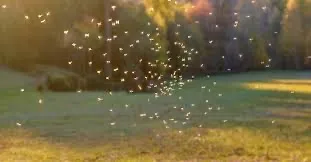
Recent days have witnessed an extraordinary and widespread invasion of flying and crawling insect swarms across several Moroccan cities, primarily affecting regions such as Salé, Kenitra, Beni Mellal, Qal'at al-Sraghna, Marrakech, Fes, and Meknes. This phenomenon, captured in numerous videos circulating on social media, has sparked considerable concern and questions among residents regarding its causes and scientific implications. The situation has coincided with an exceptional heat wave impacting these areas, with the Moroccan Directorate General of Meteorology forecasting temperatures to range between 37 and 42 degrees Celsius from May 20 to 22, 2026. Such conditions have created a conducive environment for the rapid and unusual proliferation of various insect species.
Mustafa Benramal, the president of the Al-Manara Ecological Association for Development and Climate, provided insights into this natural occurrence during a press statement. He indicated that the recent appearance of insect swarms is fundamentally linked to the severe climatic fluctuations experienced in Morocco. The abrupt transition from a cold atmosphere with rain and snowfall to excessive heat ranging between 37 and 42 degrees Celsius over a short period offers an ideal setting for certain insect species to reproduce.
Benramal further elaborated on the scientific mechanism behind this phenomenon, which unfolds in three successive stages. The first stage involves recent rainfall creating puddles and moist areas that assist insects in laying their eggs. The second stage sees rising temperatures significantly accelerating the hatching of eggs and the growth of larvae. The final stage resembles a temporary biological explosion, where insects become active in unison, particularly during the evening and night hours.
The types of insects observed in Moroccan cities include locally known mosquitoes, small flies, winged ants, tiny flying beetles, moisture insects, small cockroaches, and certain small grasshopper species. While these insects are familiar within the Moroccan ecological landscape and are not classified as dangerous or invasive, their sheer numbers have caused alarm among the populace.
Despite the concerning visuals, Benramal reassured citizens that most of these insects do not pose a direct threat to human health; however, their abundance can lead to significant annoyance or mild allergic reactions for some individuals, particularly in proximity to waste or stagnant water. He urged the public not to exaggerate the phenomenon, as it is typically seasonal and temporary, not warranting panic.
Regarding the expected duration of this occurrence, the Al-Manara Ecological Association president indicated that it could last from a few days up to approximately two weeks, contingent upon the type of insect and prevailing temperature and humidity levels. The elevated temperatures notably accelerate growth and reproduction cycles compared to normal conditions, which suggests that the phenomenon will diminish naturally once climatic factors stabilize.
To mitigate discomfort, the Moroccan expert provided several practical recommendations for citizens. These include removing stagnant water from neighborhoods and homes, regularly cleaning drainage systems and waterways, managing waste properly by securely closing trash containers, using mosquito nets and home protective measures moderately, minimizing unnecessary bright lighting near windows at night, and ensuring proper ventilation and cleaning of damp areas and dark corners.
On a broader scale, Benramal cautioned that the frequency of such occurrences may increase in the future due to climate change and environmental imbalances, particularly with the rise of sudden heatwaves and irregular rainfall patterns in Morocco. He emphasized the necessity to enhance urban cleanliness programs, combat stagnant water, and improve waste management to curb insect proliferation within cities. He affirmed that environmental and preventive measures are more effective and sustainable than an over-reliance on chemical pesticides.
Furthermore, the environmental expert called on health and environmental authorities to bolster coordination and rapid intervention in cases of unusual insect outbreaks, stating that collective prevention is the best guarantee for the health and safety of all. Scientific awareness, along with simple preventive practices, is sufficient to address this phenomenon without panic or exaggeration.
As reported by elaph.com.


